
How to Start and Grow a Successful Mobile Business on the Road
For new business owners drawn to freedom and lower overhead, a mobile business can turn a skill into income without waiting for the perfect location. The core tension is that mobile business opportunities come packaged with mobile business challenges, unpredictable schedules, travel fatigue, inconsistent demand, and the need to sell confidently in new places. Mobile entrepreneurship rewards operators who can stay organized, protect their time, and build trust quickly with people who have never heard of the brand. With the right traveling sales strategies and mindset, the road stops feeling like a risk and starts feeling like a repeatable routine.
Turn a Mobile Business Idea Into a Ready-to-Drive Setup
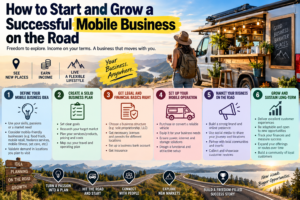
This simple roadmap helps you go from “I could do this on the road” to a real, bookable mobile service with clear costs, basic legal setup, and a vehicle that is ready to work. For general readers, the goal is to reduce guesswork so your first launch is organized, safe, and easy to repeat.
- Step 1: Validate demand with quick market research
Start by listing 10 to 20 local competitors and writing down their prices, service area, reviews, and what they do differently. Then talk to at least 15 potential customers using short questions like “What would make you hire this?” and “What would stop you?” You are looking for patterns you can serve consistently, not just compliments. - Step 2: Choose a tight service and a simple business plan
Pick one primary service you can deliver in under 60 minutes, plus one add-on that raises your average ticket without adding much travel time. Write a one page plan covering your offer, ideal customer, pricing, how you will get leads, and a weekly schedule you can sustain. Keeping it short makes it easier to follow when you are tired or busy. - Step 3: Price it by mapping startup costs and monthly break-even
List your one-time purchases (tools, equipment, initial inventory, vehicle upgrades) and your monthly bills (fuel, insurance, phone, software, supplies). Set a break-even target by dividing monthly expenses by your expected profit per job, then add a buffer for slow weeks. - Step 4: Handle legal requirements and set up your business structure
Register the business, confirm licensing and permit needs for where you plan to operate, and open a dedicated business bank account to separate personal and business spending. A basic legal checklist can keep you from missing key steps like how to choose a business structure, which affects taxes, liability, and paperwork. When in doubt, ask your city or county offices to point you to the right forms. - Step 5: Outfit your vehicle for safety, speed, and trust
Set up the vehicle so your tools are secure, your workflow is fast, and customers see a clean, professional “mobile storefront” when you arrive. Create a loading checklist, add simple branding (like a magnetic sign), and stock essentials so you are not making emergency store runs mid-day. Basic upkeep matters too, and routines like wax vehicles can help protect your exterior and keep your setup looking sharp.
Build a Vending Route That Pays: Locations, Costs, Compliance
Once your mobile setup is ready to operate, a vending route can add a steady layer of income that keeps earning while you focus on other work. A vending machine route business works like mobile retail operations: you generate revenue by placing machines in strategic spots and then running a tight routine for inventory, maintenance, and restocking schedules.
Location is the biggest lever, machines in high-traffic, repeat-visit environments tend to outperform machines that customers only pass occasionally. Before you buy equipment, get realistic about startup costs (machines, initial inventory, and any servicing needs) and choose products that match what people at each stop actually want to buy, not just what you personally prefer to stock.
It’s also important to plan for ongoing operations. Even if the model is often described as “passive,” your results depend on consistent oversight, checking sales, refilling popular items before they run out, rotating slow movers, and keeping machines working so a small problem doesn’t turn into days of lost sales. On the compliance side, requirements can vary by area, so it helps to review the steps for a vending machine route business license early so you’re not delayed once you’re ready to place machines.
Run Smoothly on the Road: Maintenance, Logistics, and Service
A mobile business only stays “mobile” if your vehicle, schedule, and service habits can handle real-world surprises. Use these operating routines to cut downtime, stay on route, and keep customers happy across changing locations.
- Build a simple vehicle maintenance plan tied to your route: Put key checks on a calendar the same way you schedule stops, weekly (tires, lights, fluids), monthly (battery terminals, wipers), and every service interval (oil, filters, brakes). Log each expense and odometer reading so you can forecast costs per route and price your stops realistically; 0.610 per kilometre is a useful benchmark for budgeting overall vehicle operating costs. When you plan routes (and permits) by neighborhood, also plan maintenance windows near those areas so you’re not losing a whole day to travel just to get serviced.
- Create a “downtime prevention kit” you check before every shift: Keep a checklist in your glove box: spare fuses, tire inflator, flashlight, basic tools, gloves, reflective triangle, phone mount/charger, paper towels, and a backup way to take payments or write receipts if your main system fails. Spend 5 minutes before leaving to confirm fuel level, tire pressure, and that your signage/menu/pricing is packed. This is the boring stuff that saves a route when something small goes wrong.
- Find a reliable mechanic before you need one: Shortlist two shops along your common route zones, one near “home base,” one near your busiest cluster of stops, and test them with a small job (inspection, oil change) before trusting them during a breakdown. Ask three questions: typical turnaround time, how they handle approvals (text/photos), and whether they can prioritize working vehicles. Keep a one-page “vehicle profile” (VIN, tire size, last service dates, warranty info) so any shop can help faster.
- Design your logistics like a route playbook, not a to-do list: For each route day, pre-pack by stop sequence: restock bins labeled “Stop 1/2/3,” a separate tote for compliance items (permits, food-safety logs, site agreements), and another for cleaning/sanitation. Track travel time, setup time, and sales by location so you can refine which stops are worth it, just like you evaluated placements and compliance earlier. Build in a 20–30 minute “buffer block” every 2–3 hours to absorb traffic, lines, or restocking.
- Adapt to customer locations with a repeatable “arrival routine”: Different sites need different approaches, office parks want speed, events want visibility, neighborhoods want quiet and courtesy. On arrival, do the same three things: confirm you’re parked legally, check foot traffic flow, and set up for the local expectation (quick-serve menu, clear signage, or pre-packed bundles). If a location has access restrictions (gates, loading docks, limited hours), save a note so you don’t relearn the same lesson next visit.
- Run mobile customer service like a system, not a personality: Write 8–10 canned responses for common questions (hours, exact location today, pricing, refunds, allergies/ingredients, out-of-stock) and keep them ready to send. Capture customer preferences quickly, name, usual order, best contact, so they don’t have to repeat themselves; more than 90% of business banking customers repeat the same information shows how frustrating that loop can be. When something goes wrong (late arrival, sold out), communicate early with a clear option: “I’ll be there at 2:20,” “I can hold one,” or “Here’s the next closest stop.”
Mobile Business Paperwork FAQs (Licensing, Insurance, Taxes)
Q: What licenses or permits do I need to operate in different areas?
A: Start with a basic business license and any industry specific permits (like food handling, vendor permits, or contractor credentials). Then confirm each place you plan to park has its own rules for vending, signage, hours, and right-of-way use. Call the local permitting office before your first day in a new zone and keep digital copies of approvals on your phone.
Q: How do I choose insurance for a business that moves every day?
A: Most mobile owners combine vehicle coverage with business policies that protect customers and gear. Common building blocks include liability insurance, plus coverage for tools or inventory and a plan for anyone helping you work. Get two or three quotes and ask specifically what happens if a claim occurs at a temporary site.
Q: Should I form an LLC right away or start as a sole proprietor?
A: Many people start simple, then switch once revenue is consistent or risk increases. An LLC can help separate personal and business liability, but it adds state filings and ongoing admin. If you are unsure, talk to a small business accountant for a quick setup recommendation based on your service type.
Q: What taxes surprise new mobile business owners the most?
A: Sales tax rules and payroll obligations can sneak up fast once you add help. Track every sale by date and location, set aside a percentage of each deposit for taxes, and file on time even in slow months. If you hire, ask your payroll provider what employer taxes apply at your wage levels.
Q: How can I avoid the most common startup cash flow crunch?
A: Underpricing and irregular demand are usually the culprits, not the idea itself. Build a minimum weekly target that covers fuel, supplies, insurance, and repairs, then keep one month of operating cash in reserve before expanding stops. If a location is unpredictable, test it for a few weeks before committing to bigger inventory.
Turn Your Route Plan Into a Reliable Mobile Business
Starting a mobile business can feel like freedom with a side of uncertainty, especially when paperwork, upkeep, and cash flow all compete for attention. The steady path is a simple one: treat mobility like a system, keep compliance and maintenance routine, and make decisions based on real demand, not just entrepreneurial motivation. Done well, the benefits of mobile businesses show up as lower overhead, wider reach, and clearer growth strategies for mobile ventures as repeat stops become predictable revenue. Build momentum by validating demand, controlling costs, and protecting your time on the road.