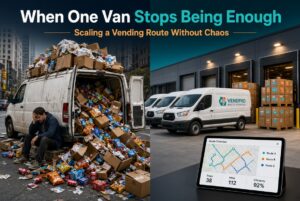

When One Van Stops Being Enough: Scaling a Vending Route Without Chaos
Nearly every vending operator begins the same way: a few machines, one vehicle, and a route that lives entirely in the owner’s head. That arrangement works beautifully right until it doesn’t. Once the machine count climbs past what one memory can track, the operation quietly starts running you instead of the other way around.
The gist in a few lines
- Informal systems that lean on memory and instinct quietly cap how large a vending business can grow.
- The four recurring bottlenecks are reactive routing, guesswork stocking, careless inventory transport, and no record of what sells where.
- A handful of steady habits — planning routes across the whole week, letting machine data guide what you pack, loading the van the same way each time, and watching product performance by location — resolve most of the waste.
- Operators who treat the route as a core operational function, not a delivery chore, are the ones who keep expanding.
Why the one-person setup runs out of road
The wall rarely arrives as one dramatic breakdown; it’s an accumulation of small inefficiencies that compound as machines multiply. A few patterns usually surface together:
- Routes get decided in the moment, driven by whichever machine someone recalls is empty, rather than sequenced for the shortest, fullest trip.
- Restocking amounts come from a feel for what “usually moves,” not from what the machines actually recorded.
- Product travels from warehouse to van to machine in whatever order it was grabbed.
- No one can say with confidence which items earn their slot at a given site.
Spread across dozens of machines, those habits bleed hours, fuel, and spoiled stock every week.
Getting product there in one piece
A cost most growing operators underestimate is the money that vanishes between the loading dock and the machine door. Boxed snacks, canned drinks, and bottled beverages are heavy and awkward, and they slide the instant a van takes a hard corner, arriving dented or split before a customer sees them. The remedy is refreshingly simple: sturdy straps that pin everything down so cases sit exactly where you stacked them. Industrial packaging specialists carry these in a range of strengths, and you can find load restraint solutions here for a price that earns itself back the first time a full stack doesn’t topple. For anyone replenishing machines several times a week, keeping cargo steady is straight margin you get to keep.
Habits that keep a growing route sharp
Tightening up needs discipline more than technology, so run through these steps before your next round.
Map the full week at once
Group every machine due for service by geography and urgency so each trip is as short and as full as possible.
Pack from the numbers
Check each machine’s recent sales before loading, and bring what actually sells there instead of a default mix.
Load the vehicle the same way every time
Give each product category a fixed spot so restocking becomes routine rather than a scavenger hunt.
Flag the slow movers
At every stop, note what’s gathering dust and swap it for something that location genuinely wants.
Route management as a business function, not an errand
Here’s the shift that matters most: for a vending operator, the route isn’t the thing you do before the real work — it is the real work. The gap between treating it as a driver’s task and running it as a deliberate function shows up everywhere, roughly like this:
Aspect | Run as a task | Run as a function |
| Routing | Decided reactively that day | Sequenced ahead for the week |
| Stocking | Habit and hunch | Each machine’s sales history |
| Loading | Whatever gets grabbed | Standardised for speed and safety |
| Product mix | Same everywhere | Tuned to each location |
| Growth | Caps at one person’s memory | Scales past it |
Operators who make that leap add machines without adding disorder, because the system holds the knowledge instead of one exhausted person.
Straight answers before you overhaul your route
A few practical questions come up almost every time an operator decides to formalise things.
How many machines before this becomes urgent?
There’s no fixed number, but the strain usually bites somewhere between fifteen and thirty machines. It depends on how spread out your sites are and how fast they sell through. If you’re already forgetting stops or guessing quantities, you’re there.
Do I need expensive software to fix this?
Not to begin with; a spreadsheet, your machines’ own sales reports, and a consistent weekly plan clear most of the waste. Software helps once you’re past a certain scale, but the habits matter far more than the tools. Fix the process first, then buy technology that supports it.
Is sales data really better than my own experience?
Your instincts are valuable, yet they can’t track dozens of machines with different crowds. The data simply reports what happened at each specific spot, which is often surprising. The strongest results come from pairing your judgment with the numbers.
Why does van loading matter so much?
A messy load slows every stop, and that delay multiplies across a full route into real lost time. Consistent loading also cuts damage and makes shortages obvious before you leave. It’s among the cheapest efficiency gains available.
What should I change first if I’m overwhelmed?
Start by planning the coming week’s routes all at once rather than stop by stop. That single move tends to expose how much backtracking you’ve been doing. Sales-based stocking then slots in naturally.
The bottom line
Scaling a vending business isn’t about owning more machines; it’s about building a route that won’t buckle under its own weight. When routing, stocking, loading, and tracking each run on a system instead of someone’s recall, growth becomes repeatable rather than stressful. Treat the route as the strategic centre it truly is, and the machines will follow.