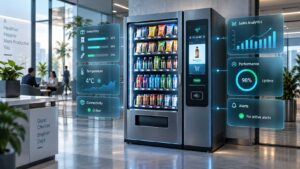

Smart Vending: Integrating Control Panels for Enhanced Performance and Monitoring
30 seconds summary
Smart vending machines are becoming more efficient by integrating advanced control panels that connect and manage key machine functions.
These panels help monitor temperature, inventory, power consumption, payment systems, and machine performance in real time. With the right control panel accessories, such as sensors, displays, communication modules, and safety components, operators can detect problems quickly, reduce downtime, and improve energy efficiency.
Remote monitoring also allows businesses to track sales and maintenance needs without visiting each machine. Overall, smart control panels make vending systems more reliable, connected, and cost-effective while delivering a better customer experience.
Smart vending machines have transformed the traditional concept of automated retail. Once designed primarily to dispense snacks, beverages, or other products after a simple payment transaction, modern vending machines now operate as connected, intelligent systems that monitor inventory, process multiple payment methods, collect customer data, detect technical problems, and communicate with remote management platforms. At the heart of this transformation is the control panel—the central interface that allows vending-machine operators, technicians, and users to interact with the machine and its electronic systems.
The development of smart vending technology has created a growing need for reliable control panel accessories. These accessories support everything from user interaction and payment processing to connectivity, security, power management, and equipment monitoring. When properly integrated, they can improve machine performance, reduce maintenance requirements, increase operational efficiency, and create a smoother customer experience.
Understanding Smart Vending Technology
A smart vending machine combines traditional mechanical dispensing equipment with electronic controls, sensors, communication technologies, and software. Instead of functioning as an isolated machine, it can become part of a broader automated retail network.
A typical smart vending system may include:
A central control board or controller
A user-facing control panel
Touchscreen or physical buttons
Product-selection interfaces
Payment terminals
Inventory sensors
Temperature sensors
Door and security sensors
Connectivity modules
Cameras or monitoring equipment
Lighting systems
Motors and dispensing mechanisms
Remote management software
Power-management components
The control panel connects these components. It can display information to customers, receive commands, communicate with the central controller, and provide technicians with access to machine settings and diagnostics.
As vending machines become more sophisticated, the control panel is no longer simply a collection of buttons. It can function as an intelligent operating interface that brings multiple systems together.
The Role of Control Panels in Smart Vending
A control panel is essentially the command center of a vending machine. It enables users and operators to communicate with the machine’s electronic system.
For customers, the control panel can provide product selection, pricing information, payment instructions, promotional messages, and transaction confirmations. For operators and technicians, it can provide access to configuration settings, diagnostic information, inventory information, error codes, and maintenance functions.
Modern control panels may incorporate touchscreens, illuminated buttons, digital displays, card readers, QR-code scanners, biometric technologies, or other interactive devices.
The control panel’s importance grows as vending machines become more connected. A machine that accepts cash only has relatively straightforward control requirements. A smart vending machine that accepts contactless payments, monitors product temperatures, tracks inventory, and communicates with a cloud platform requires a much more capable interface.
The control panel must therefore be reliable, intuitive, durable, and compatible with the machine’s broader electronic architecture.
Control Panel Accessories for Smart Vending Machines
Control panel accessories are essential components that extend a vending-machine interface’s functionality. Depending on the machine’s purpose and operating environment, you may need different accessories.
1. Push Buttons and Selection Controls
Physical push buttons remain useful in vending machines because they are straightforward, durable, and easy to operate. They can be used for product selection, navigation, confirmation, cancellation, or service functions.
Industrial-grade buttons are particularly valuable in machines operating in high-traffic environments. Their construction needs to withstand repeated use, accidental impacts, dust, and temperature variations.
Illuminated push buttons can further improve usability by making controls easier to identify in low-light conditions. Different illumination patterns can also communicate machine status, for example, indicating an available selection, successful payment, or temporary fault.
2. Touchscreen Displays
Touchscreens are becoming increasingly common in smart vending machines. They let manufacturers provide a flexible interface without requiring many physical buttons.
A touchscreen can display product images, prices, nutritional information, promotions, payment instructions, and multilingual menus. Software updates can also change the interface without requiring physical modifications to the machine.
However, touchscreen control panels must be designed for real-world vending conditions. The screen should be responsive, scratch-resistant, and suitable for frequent public interaction. Outdoor vending machines may also need additional protection against moisture, sunlight, and temperature fluctuations.
3. Keypads
Numeric and multifunction keypads remain useful for entering product codes, PINs, service commands, and other information. They can provide an alternative to touchscreen interfaces, especially where simple, rapid input is required.
For service technicians, a dedicated keypad can provide access to maintenance menus and machine configuration settings without exposing those functions to ordinary customers.
4. LED Indicators
LED indicators are small but important control panel accessories. They can communicate machine conditions quickly and clearly.
For example, an LED may indicate:
Power status
Product availability
Payment status
Network connection
System errors
Maintenance requirements
Door status
Because LEDs consume relatively little power and can remain visible under many lighting conditions, they are useful for both customer interfaces and technician-oriented control panels.
5. Payment Interfaces
Payment functionality is one of the most important areas of smart vending. Modern machines may accept credit and debit cards, contactless payments, mobile wallets, QR codes, cash, or other digital payment methods.
Payment terminals and associated control-panel components must communicate securely with the vending machine’s controller. Their placement is also important. Customers should be able to identify the payment area easily while maintaining a logical flow from product selection to payment.
Integrating payment controls into the main interface can reduce confusion and make transactions faster.
6. QR-Code Scanners
QR-code scanners can support payments, loyalty programs, promotions, product information, and digital authentication.
For example, a customer could scan a code displayed on their phone to initiate a transaction. Alternatively, the machine could display a QR code that customers scan to receive a digital receipt or promotional offer.
Integrating the scanner into the control panel creates a compact interface while reducing the need for separate external equipment.
Monitoring and Diagnostic Accessories
One of the greatest advantages of smart vending machines is their ability to monitor themselves. Control panels and related accessories provide access to this information.
Temperature Sensors
Temperature monitoring is especially important for refrigerated vending machines. Sensors measure internal temperatures and send data to the control system.
If the temperature rises beyond an acceptable range, the machine can generate an alert. Depending on the system, the operator may receive a remote notification, allowing them to investigate the problem before products are damaged.
This type of monitoring is particularly valuable for vending machines selling beverages, fresh foods, medicines, or other temperature-sensitive products.
Door Sensors
Door sensors can monitor whether the machine’s service door or product compartment has been opened. This provides useful information for security and maintenance.
A smart vending machine can record when a door was opened and potentially generate an alert when unauthorized access occurs.
Inventory Sensors
Inventory management is another major application of smart control systems. Sensors can monitor product levels and provide data to the machine’s central controller.
Instead of relying entirely on manual inspection, operators can use inventory information to determine which machines require replenishment.
This can make restocking more efficient because employees can prioritize machines that are actually running low.
Motor and Dispensing Monitoring
Vending machines depend on motors, spirals, conveyors, pumps, or other mechanisms to deliver products. A dispensing failure can lead to customer dissatisfaction and refunds.
Control systems can monitor motor activity and detect situations in which a dispensing command is issued but the expected operation does not occur.
Diagnostic information can then help technicians identify problems more quickly.
Connectivity and Remote Monitoring
Connectivity is what turns an ordinary electronic vending machine into a smart vending system.
Control panels can integrate communication modules that connect machines to remote management platforms. Depending on the system, communication may use cellular networks, Wi-Fi, Ethernet, or other technologies.
Remote connectivity allows operators to monitor information such as:
Sales activity
Product inventory
Machine status
Temperature
Payment activity
Error conditions
Maintenance requirements
Network status
This eliminates the need for operators to visit every machine just to confirm it is functioning normally.
For companies managing large vending fleets, remote monitoring can produce substantial operational benefits.
Improving Performance Through Better Control Panels
A well-designed control panel can improve vending-machine performance in several ways.
First, it can simplify the interaction between different electronic systems. Rather than treating payment, product selection, monitoring, and diagnostics as separate functions, the control architecture can integrate them.
Second, it can improve responsiveness. Customers expect transactions to be fast. Delays in product selection, payment confirmation, or dispensing can negatively affect the customer experience.
Third, control panels can provide technicians with useful diagnostic information. Instead of spending significant time determining what has failed, technicians can use system messages and error codes to identify potential problems.
Fourth, a properly designed interface can reduce operator errors. Clear menus, labels, indicators, and controls make machine configuration and maintenance easier.
Enhancing Customer Experience
The control panel is one of the few parts of a vending machine that customers interact with directly. Consequently, its design strongly influences customer satisfaction.
A modern interface should be simple enough that a first-time customer can understand it immediately.
Important considerations include:
Visibility: Product information, prices, instructions, and controls should be easy to see.
Accessibility: Position controls at practical heights and design them for a broad range of users.
Responsiveness: Touchscreens and buttons should respond quickly.
Feedback: The machine should clearly communicate whether a selection or payment was successful.
Error handling: When something goes wrong, the machine should provide understandable instructions rather than confusing technical messages.
Payment convenience: Customers should have access to appropriate modern payment methods.
These factors can turn a technically sophisticated machine into a genuinely user-friendly retail solution.
Security Considerations
Smart vending machines increasingly require security at both the physical and digital levels.
Control panels may need protective housings to prevent unauthorized access to internal components. Service controls should generally be separated from customer-facing functions.
Access codes, authentication systems, and secure maintenance menus can help prevent unauthorized configuration changes.
Digital security is equally important. Connected vending machines transmit operational and potentially transactional information over networks. Manufacturers should therefore consider secure communication, software updates, authentication, and access management.
Accessories such as tamper sensors can provide additional protection. If the control panel or service door is physically disturbed, the system may record the event or notify an operator.
Power Management and Reliability
Vending machines often operate continuously, making power efficiency important. Select control-panel components with the machine’s overall power budget in mind.
Low-power LEDs, efficient displays, well-managed communication modules, and intelligent sleep modes can reduce energy consumption.
Reliability is equally important. A vending machine that operates in a busy shopping center, transport station, school, office, or outdoor location may experience thousands of interactions over its service life.
Select control panel accessories based on expected usage, environmental conditions, and maintenance requirements.
Industrial-grade components can provide advantages where high durability is required.
Outdoor Smart Vending Applications
Outdoor vending machines face additional challenges. They may be exposed to rain, dust, direct sunlight, temperature extremes, and vandalism.
For these applications, control panels may require protective enclosures, weather-resistant switches, sealed connectors, durable displays, and appropriately rated components.
Screen visibility is another major concern. A display that works well indoors may become difficult to read under bright sunlight.
Similarly, physical controls must be designed to tolerate environmental exposure.
Control panel accessories should therefore reflect the actual operating environment rather than focusing only on appearance or initial cost.
Maintenance and Predictive Monitoring
One of the most valuable developments in smart vending is the movement from reactive maintenance toward predictive maintenance.
Traditional vending maintenance often follows a simple pattern: a machine develops a problem, a customer reports it, and a technician investigates.
Smart monitoring can identify warning signs before complete failure occurs.
For example, repeated motor errors may indicate that a dispensing mechanism requires servicing. Increasing internal temperatures may suggest refrigeration problems. Repeated communication failures could indicate a connectivity or hardware issue.
By collecting this information through sensors and control systems, operators can schedule maintenance more intelligently.
Control panel diagnostics can then provide technicians with relevant information when they arrive at the machine.
Conclusion
Smart vending represents a significant evolution from conventional automated retail. By combining connected electronics, sensors, payment technologies, remote monitoring, and intelligent software, vending machines can operate as sophisticated retail platforms rather than simple product dispensers.
At the center of this ecosystem is the control panel. It provides an interface between customers, technicians, machine hardware, and management systems. The addition of appropriate control panel accessories, including push buttons, touchscreens, LED indicators, keypads, payment terminals, QR scanners, sensors, and communication components, can dramatically expand what a vending machine is capable of doing.
Effective control-panel integration can improve performance by enabling faster transactions, better diagnostics, more accurate monitoring, and easier maintenance. It can also improve customer satisfaction through clearer interfaces and more convenient payment options.